
Agents that reason, act and orchestrate real work.
We design agentic systems around business workflows, enterprise data and the tools people already use — with the controls required to move from a convincing demo into production.
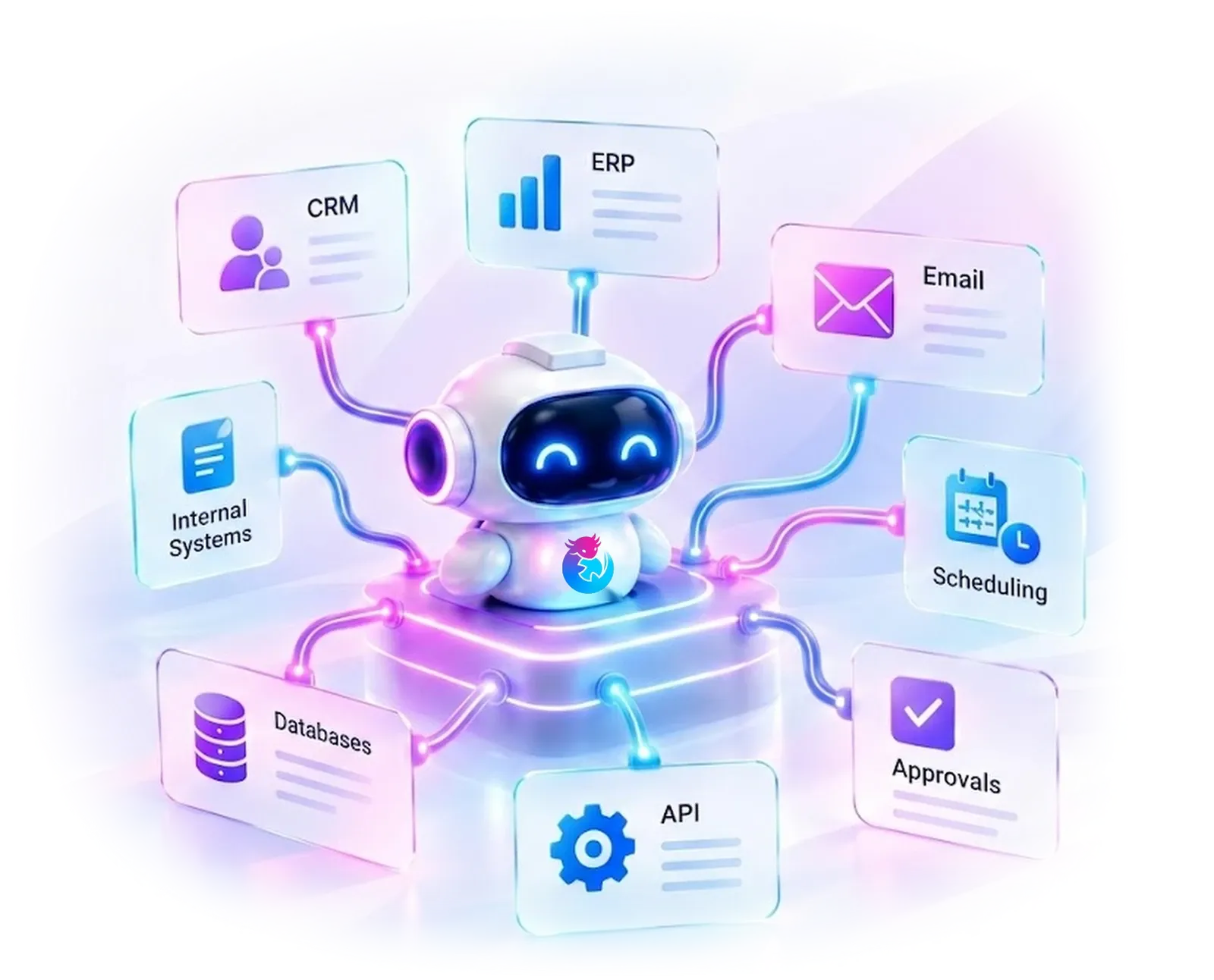
How it works
Turn AI from an answer engine into part of the workflow.
An agent becomes valuable when it can understand context, choose the right tools, coordinate steps and know when a person should stay in control. We design the entire system around that loop.
-
Ground agents in trusted business context and data.
-
Connect tools, APIs and enterprise applications safely.
-
Add approvals, policies and explicit execution boundaries.
-
Observe decisions, tool calls, latency, cost and outcomes.
The system
A production agent is a controlled loop, not just a model call.
Context, tools, policy, evaluation and human approval surround the model so the agent can do useful work without losing operational control.
Grounded context
Agents receive the right business context, not an uncontrolled dump of enterprise data.
Bounded autonomy
Permissions, approvals and execution policies define what the agent may do on its own.
Observable behavior
Tool calls, cost, latency, failures and outcomes become measurable parts of the system.
Where projects stall
A model demo is easy. A dependable business agent is a software system.
-
The agent has no trustworthy context
Without retrieval, state and provenance, the model is forced to guess or depend on whatever fits in a prompt.
-
Tool access is too broad or too brittle
Production agents need explicit permissions, typed tool contracts, validation and safe handling of partial failures.
-
There is no operational feedback loop
Teams need traces, evaluations, cost visibility and outcome metrics to understand why the agent behaves the way it does.
What we build
Agent capabilities designed for real operations.
The implementation can range from one focused agent to a coordinated multi-agent system depending on the workflow.
-
Task & workflow agents
Agents that interpret requests, plan work and coordinate multiple steps across internal systems.
-
Knowledge agents
Grounded assistants that retrieve from trusted enterprise sources and preserve citations or provenance.
-
Tool orchestration
Connect APIs, MCP servers, SaaS products and internal services behind controlled agent actions.
-
Human-in-the-loop controls
Approval gates, policies and escalation paths for actions where autonomy should remain bounded.
How we work
Start with one workflow, then earn more autonomy.
Agent projects work best when capability grows alongside evidence, observability and trust.
- 01
Find the workflow
Choose a process with clear friction, usable context and a measurable definition of success.
- 02
Build the agent loop
Design prompts, tools, memory, retrieval and execution boundaries around the actual task.
- 03
Evaluate behavior
Test quality, tool selection, failure modes, security boundaries, latency and cost before scaling.
- 04
Expand safely
Add workflows, tools and autonomy only after the system demonstrates reliable behavior in production.
The model is only one layer of the architecture.
What you get
The production architecture is the product.
Every engagement ships these layers as working, documented parts of the system, not slides.
- Layer 4
Context & memory
Retrieval, state, conversation history and domain context with clear source boundaries.
- Layer 3
Tool layer
APIs, MCP servers, SaaS actions and internal services exposed through controlled, observable contracts.
- Layer 2
Guardrails & approvals
Policies, scopes, confirmation points and escalation paths that define where autonomy stops.
- Layer 1
Evaluation & observability
Traces, datasets, behavioral evaluations, latency, cost and business outcome signals.
Where to start
Put agents where context gathering and coordination consume the most human time.
The best starting points are bounded workflows with clear tools, usable context and a measurable definition of success.
-
Research & investigation agents
Collect information across approved sources, organize evidence and prepare a structured brief for human review.
-
Communication workflows
Draft, classify, route and follow up on messages using business context and explicit approval rules.
-
Operations agents
Coordinate routine steps across systems while surfacing exceptions instead of hiding them.
-
Engineering agents
Use repositories, tickets, documentation and internal tools to assist technical workflows.
-
Employee copilots
Give teams one conversational surface for policies, procedures, systems and guided actions.
-
Analyst copilots
Gather context, summarize findings and suggest next actions while keeping consequential decisions with the user.
Before we start
Questions we hear first.
Practical answers. The exact architecture depends on the workflow, constraints and systems already in place.
Do we need a multi-agent system?
Usually not at the beginning. One well-bounded agent with a clear workflow is easier to evaluate and operate. Multiple agents make sense only when responsibilities or context boundaries are genuinely distinct.
How do you keep an agent from taking the wrong action?
Permissions, typed tools, validation, policy checks and human approval gates are designed around the consequence of each action. The model should never be the only control layer.
Can agents use our internal systems?
Yes, when those systems expose safe integration points. APIs, MCP servers, queues and purpose-built adapters can all be used behind explicit identity and authorization boundaries.
How do we know whether an agent is actually working?
We define task-level evaluations and operational metrics before scaling. Quality, completion rate, escalation rate, latency, cost and downstream business outcomes can all be part of the feedback loop.
Tell us what you want to build.
We reply within one business day — a person from the team, not an autoresponder.