
MCP for IT Leaders: Connecting AI Agents to the Systems You Already Run
MCP is now an open standard for connecting AI agents to your systems. What it means for your ERP, your CRM and your internal systems, and what to get right before you connect them.
 Written byGustavo Barrientos
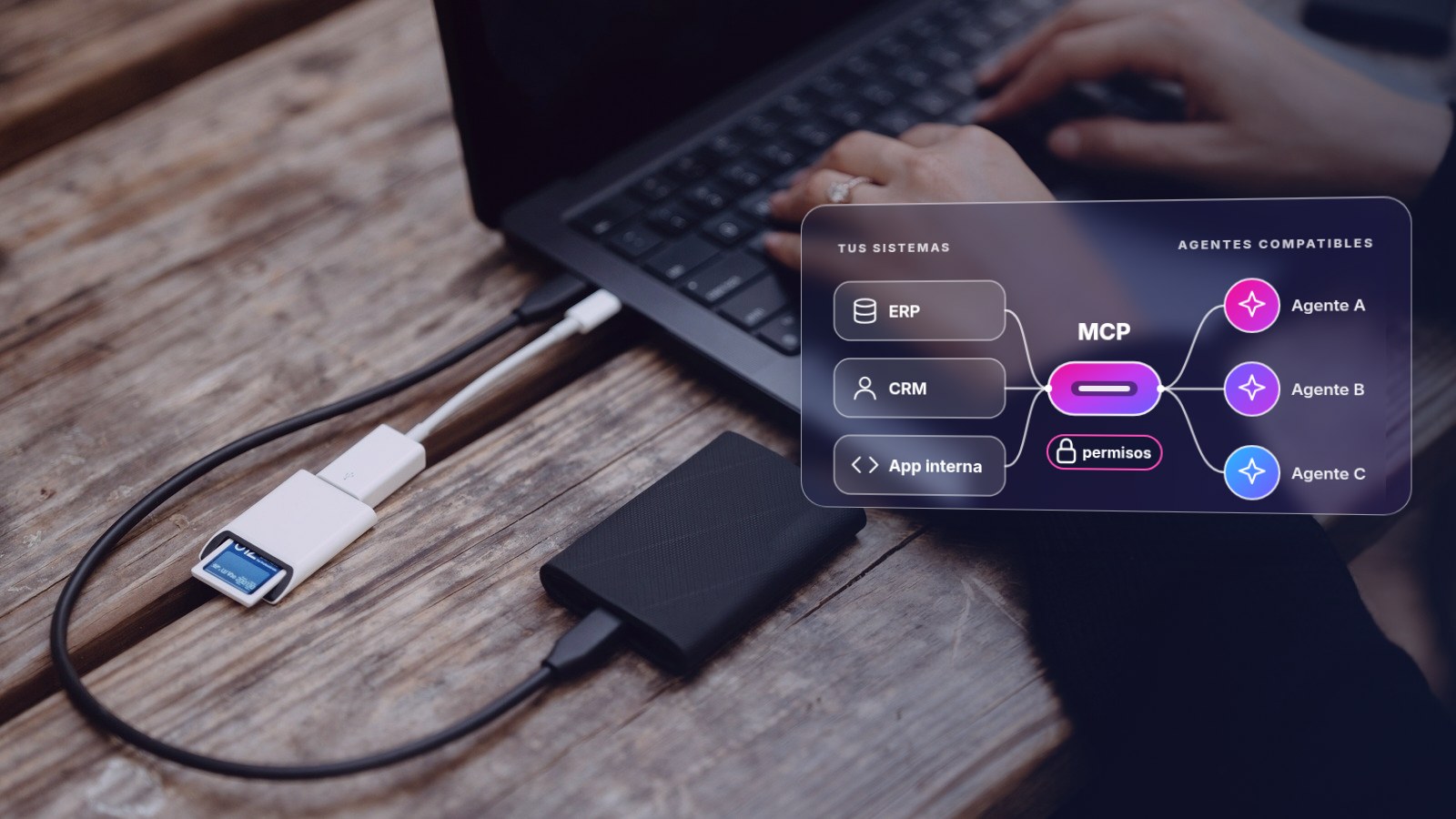
MCP is now an open standard for connecting AI agents to your systems. What it means for your ERP, your CRM and your internal systems, and what to get right before you connect them.
Sooner or later, every IT team that has tried an AI agent runs into the same question: fine, it answers questions, but can it query the ERP? Can it check an order’s status in the system we built in-house ten years ago?
Until recently, the honest answer was “yes, with a custom integration for every model and every system.” That is changing, and the change has a name: Model Context Protocol, or MCP.
A standard, not another fad
MCP is an open protocol for connecting AI models to tools, data and applications. Think of it as the USB-C of AI: just as one USB-C port connects devices from different brands, you expose your system once and any compatible agent can use it. And you decide what gets exposed and with which permissions.
What makes it relevant to an IT leader is not the technology. It is the governance. In December 2025, Anthropic donated MCP to the Agentic AI Foundation, a new foundation under the Linux Foundation, with Microsoft, Google, AWS and OpenAI among its principal members. According to the official announcement, more than 10,000 MCP servers had already been published at that point, and the protocol ran on Microsoft Copilot, ChatGPT, Gemini and VS Code, among other platforms.
What this means for your systems
Most companies in Mexico are not going to replace their ERP to get agents, and they don’t need to. With MCP, the question stops being “which system do we buy?” and becomes “which capabilities of what we already have do we want an agent to use, and with which permissions?”
Not even Mexico’s tax and banking operations are left out. Third-party MCP servers already exist to generate or validate CFDI invoices and to look up SPEI transfer receipts. What you won’t find in any catalog is the server for your collections system, your supplier portal, or that .NET application only two people on your team understand. That one has to be built by someone who knows how your operation works.
The catalog is no guarantee
An MCP server existing doesn’t mean it’s ready for production. In October 2026, MCPMarkets analyzed nearly 6,000 public MCP servers and found that only 28.7% included a runnable install command in their documentation. If seven out of ten don’t document something that basic, it’s worth asking what happens with permissions, credential handling, or the record of what the agent does.
That’s the part that never shows up in demos. Connecting is easy. Deciding what an agent can read, what it can execute, what needs a person’s approval and how every action is audited is what separates an experiment from a system your CFO can trust.
The question worth asking
Don’t start with “how do we implement MCP?” Start with “which system, if an agent could use it tomorrow, would save us the most work?” The answer is often surprising, and it’s almost never the newest system. At Ambystech, we help you find it and connect that integration, with clear permissions and a person approving what matters.
Which of your systems could your agents use tomorrow?
 Written by Gustavo Barrientos CTO & Co-Founder · Ambystech · AI Solutions & Software Engineering